
Is WCAG Required by Law?
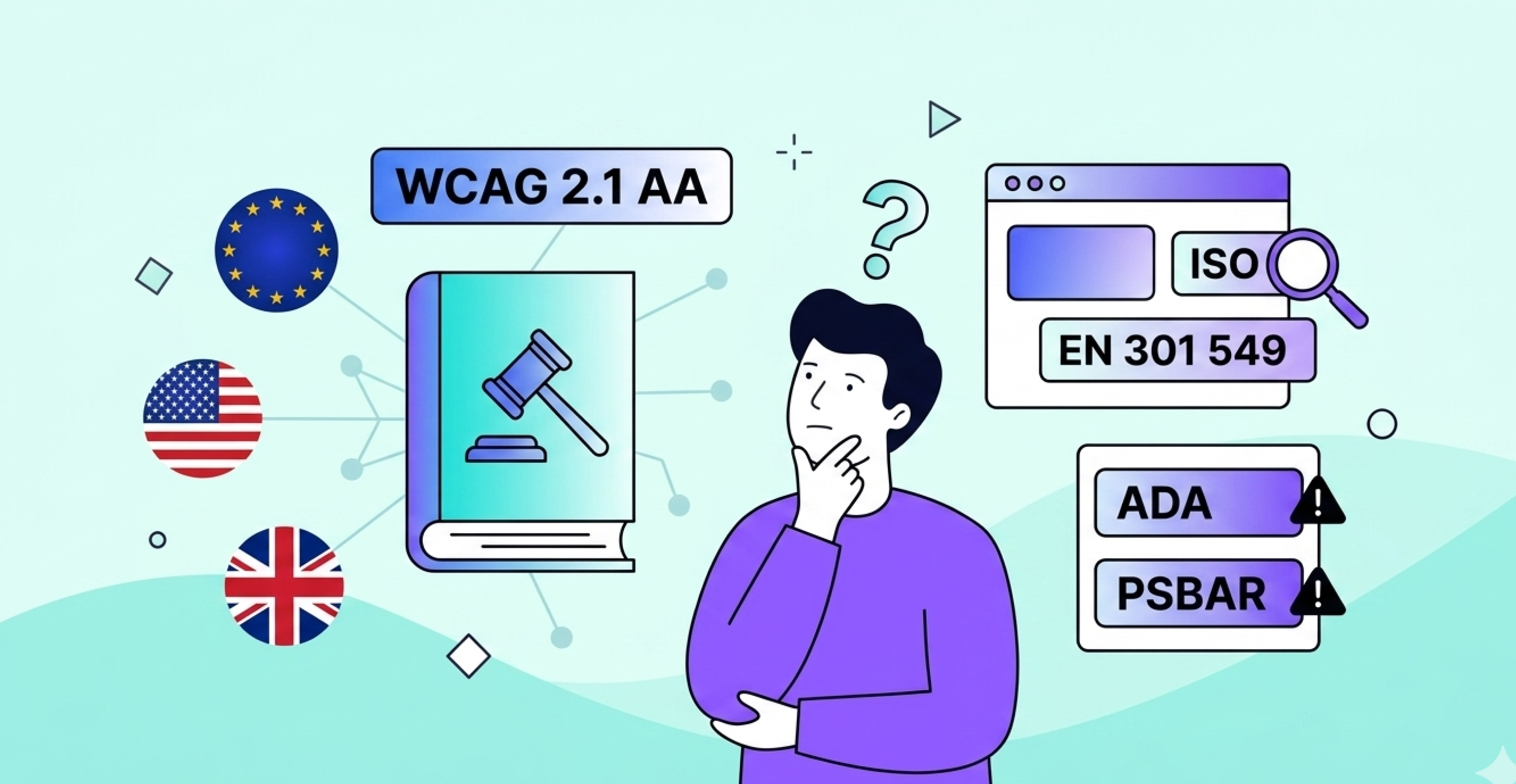
No. Not in the United Kingdom. Not in the USA. Not technically.
WCAG is a guideline produced by the W3C (the international body responsible for global web standards). It’s not a government; it is being treated like law in practice. Courts, regulators, and enforcement bodies are using WCAG 2.1 Level AA as the benchmark for deciding whether a company's website discriminates against people with disabilities.
So while WCAG guidelines are not the law itself, ignoring them puts you on the wrong side of laws that do carry real financial penalties.
What Is WCAG?
WCAG stands for Web Content Accessibility Guidelines. Developed and maintained by the World Wide Web Consortium (W3C), it sets out technical requirements for making digital content accessible to people with visual, auditory, motor, cognitive disabilities, or emotional impairments.
The guidelines are split into three levels:
- Level A — basic minimum requirements
- Level AA — the standard referenced in nearly all legislation and lawsuits
- Level AAA — enhanced, typically applied to specialist or high-risk contexts
Several versions have been created over the year. The version most widely referenced in law is WCAG 2.1, published in 2018. WCAG 2.2 was released in October 2023 and is quickly being adopted in certain jurisdictions, most notably in the UK, where PSBAR was updated to require WCAG 2.2 AA from October 2024.
Here is how it plays out in the UK, US, and EU.
The UK
The primary legislation governing disability discrimination in the UK is the Equality Act 2010. It applies to all organisations, private businesses, charities, and public bodies, and requires them to make reasonable adjustments so that disabled people can access their services. Websites fall clearly within the scope of this.
Although the Equality Act does not mention WCAG by name, courts accept demonstration that a website meets WCAG 2.1 Level AA as sufficient evidence of a reasonable adjustment. In practice, it is the closest thing to a legal safe harbour you can get.
Public sector is a different conversation. Councils, NHS trusts, universities, and schools are bound by the Public Sector Bodies Accessibility Regulations 2018, which go beyond the Equality Act and set a hard legal requirement for accessible websites. Those regulations were updated in October 2024 to require WCAG 2.2 AA. If you're still working to 2.1, you're behind.
The US
The US is the most litigious environment for web accessibility in the world. The Americans with Disabilities Act (ADA) prohibits discrimination in places of public accommodation, and courts have consistently ruled that websites qualify. That position has been tested in court hundreds of times
Over 5,000 ADA accessibility lawsuits were filed in the US in 2025. That's not a niche legal problem anymore. Retail and e-commerce take the bulk of it, with 70% of all cases.
There's a common assumption that it's mostly small businesses getting caught out. That's changing. In 2023, 27% of companies sued had revenues above $25 million. By 2025, that figure was 36%. Legal firms are deliberately moving upmarket, targeting brands with the traffic and the budget to settle. (UsableNet, 2025)
Interestingly, 45% of federal cases in 2025 were filed against companies that had already been sued before. Reinforcing the point that getting sued once and doing the minimum is not a strategy. (UsableNet, 2025)
For federal agencies and organisations receiving federal funding, Section 508 of the Rehabilitation Act imposes a direct requirement to meet WCAG 2.0 Level AA. There is active pressure to update this to WCAG 2.1.
The key point for US businesses: you do not have to wait for a regulator to come to you. Private lawsuits under the ADA are the main enforcement mechanism, and they are a routine business risk in many sectors.
The EU
The European Accessibility Act, also known as EAA, (Directive 2019/882), came into force across EU member states in June 2025. It is the most significant expansion of digital accessibility law in Europe and applies to a wide range of private sector businesses
Businesses within scope include those operating in:
- E-commerce
- Banking and financial services
- Transport booking and services
- Streaming and media services
- Telecoms
The technical standard used to assess compliance is EN 301 549, which references WCAG 2.1 Level AA. Enforcement is handled nationally, with each EU member state designating its own authority. Penalties vary but can be substantial; in some member states, fines reach tens of thousands of euros.
If you sell to consumers in the EU, the EAA almost certainly applies to you, regardless of where your business is based.
What Are the Penalties?
United Kingdom
- Via employment tribunal or civil court.
- No statutory cap on damages.
- Can face regulatory action and mandatory publication of their compliance failures.
United States
- Typically a few thousand dollars to over $125,000, plus legal costs.
- The DOJ can also bring independent enforcement actions.
- Repeat offenders face escalating scrutiny.
European Union
- Serious or repeated violations ranging from €10,000 to €100,000
- Ongoing penalties for continued non-compliance.
- Complaints can cause real reputational damage, particularly for consumer-facing brands.
Conformance vs Compliance
These two words are often used interchangeably. They mean different things.
Conformance is a technical assessment; your website either meets WCAG criteria or it does not. It is measured through audits.
Compliance is a legal concept; simply, whether you have met your obligations under applicable law.
A website can be partially conformant with WCAG and still be considered legally compliant if you have documented your efforts, published an accurate accessibility statement, and demonstrated good faith.
Conversely, a site that claims full WCAG conformance without proper testing may face greater scrutiny if a complaint is raised.
How you document and communicate your accessibility status matters, not just the technical state of your website.
What This Means for Your Business
The legal picture in 2026 is becoming harder to ignore. The ADA Title II compliance deadline was originally set for April 2026 (now 2027) is pushing accessibility up the agenda for public bodies across the US. The EAA is now in force across the EU. PSBAR in the UK has just raised its standard to WCAG 2.2.
The businesses most exposed are those that:
- Have never had an accessibility audit
- Rely entirely on automated scanning tools, which identify around 30-40% of actual issues at best
- Publish accessibility statements that do not accurately reflect the real state of their site
- Operate in sectors specifically named in the EAA
The businesses best positioned are those that treat accessibility as an ongoing practice with regular testing, clear documentation, a process for handling user feedback, rather than a one-off box to tick.
There is also a commercial case worth making. The Click-Away Pound study estimated that UK businesses lose approximately £11.75 billion annually because disabled users abandon websites they cannot use. Accessibility is not just a compliance question. It is also a conversion problem.
Where to Start
First, start with an automated scan. Automated scanning tools such as WAVE, Axe, Google Insights, and our very own scanner here at Accessima quickly allow developers to identify structural errors.
Second, getting an independent accessibility audit will give you an overall picture of your website’s level of accessibility. The results will include details about every accessibility error, their level of severity, and provide you with specific guidance as to how you can address each issue.
If you'd like us to review your site and explain everything in plain English, book a free consultation! We'd be more than happy to guide you through our basic evaluation process.