5 min read
On 28th June 2025, the EU Accessibility Act 2025 came into effect across all EU countries. This law sets out specific accessibility standards for any product or service that is launched onto the EU market. However, companies selling products already in the EU market will have until 28th June 2030 to bring their products up to the required standards. If a company makes any changes to a product already on sale (including updating an interface), they could be seen as launching a new version of that product, thus requiring them to make their product compliant with the Act at that time too.
The European Accessibility Act is very wide-ranging. Below is a summary of the types of products covered under the Act, and what the implications are for businesses.
Types of Product Covered Under the Act
There are eight main product and service types included under the Act.
Computer Software and Computer Systems
Desktop computers, laptops, tablet computers, smart phones and operating systems must allow users to navigate using the keyboard alone; to be used with screen magnification software and/or voice activation; to be compatible with assistive technology in general, and to have detailed instructions provided by the manufacturer on how to enable these features.
Self-Service Machines
Automated teller machines (ATM’s); ticket machines, self-service check-in kiosks, etc., must contain tactile buttons; provide auditory assistance; provide adjustable contrast settings; and provide legible labels. There should also be a facility to connect headphones or use near-field communication (NFC) to access the auditory assistance, to avoid having to navigate through menus to access this feature.
Audio/Visual Equipment
Smart televisions, set-top boxes, digital television recorders, DVD players, etc., must be able to display subtitles for live and pre-recorded programmes; announce menu and playback options via an audible announcement option; and provide a clearly labelled or raised (embossed) remote control.
Telecommunications
Internet portals (e.g. broadband); Voice over Internet Protocol (VoIP) telephone calls; instant messaging applications (e.g. chat platforms); video calling applications (e.g. Skype); must be able to offer real-time alternative text; integrate relay services; and must identify interactive items within the accessibility tree correctly.
Travel Booking Services
Air travel, rail travel, bus travel, ferry travel; booking platforms (online and offline) must provide step-by-step form guidance; clear focus indicators; skip links; and spoken error messages. If a user misses a required field, the interface must explain exactly which field failed, rather than simply indicating which field was missed.
Banking Services
Online and mobile banking portal; ATM’s; Payment terminals; must include accessible PIN entry, voice prompts, large print options, and receipt options in accessible formats (i.e. audio).
Reading Materials
E-book readers: Dedicated e-book reading applications must allow users to resize fonts, must allow users to listen to text-to-speech, must allow users to navigate between chapters using the keyboard alone, and must provide screen-reader announcements for all menus and controls.
E-commerce
All online shopping platforms must provide alternative (alt) text for all product images; must allow customers to complete purchases using the keyboard alone; must announce any dynamic page updates (e.g. changes to the shopping cart; filtering options) to screen-readers; and must ensure that all error messages are both clearly communicated and action-able.
Standards
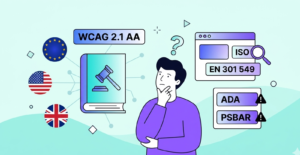
All of the requirements above relate to the European Standard for Information and Communication Technologies (ICT) Accessibility, known as EN 301 549. For web and application content, this is aligned with Web Content Accessibility Guidelines (WCAG) 2.1 Level AA. Hardware-based products require additional requirements regarding tactile markers, audio status cues, and accessible documentation.
Responsibility
The Act lists five types of responsible parties: Manufacturers, Authorised Representatives, Importers, Distributors, and Service Providers.
If a company designs, brands, distributes, or sells a product or service in the EU from 28th June 2025 onwards, then the responsibility lies with that company.
To demonstrate compliance, the product must be audited to map the product against the relevant clauses; tested to determine compliance; produce a Declaration of Conformity; and apply the CE mark where necessary.
EU Accessibility Act 2025: Enforcement and Fines
Each national authority in each EU member state will investigate any complaint lodged, request technical documentation, and impose fines upon those who fail to comply with the Act. The amount of fine imposed varies by country, but can exceed €20,000 per failure. Repeated non-compliance can result in a product recall. The damage to a company’s reputation caused by a publicly disclosed complaint, especially one that occurs in multiple EU member states, can often exceed the costs associated with the fine itself.
What to do now
If your organisation has an online presence in the EU, or sells to EU consumers, the 28th June 2025 deadline has already passed. Enforcement is now live, and this is something to act on immediately.
The most effective approach combines automated scanning with manual testing.
First, start with an automated scan. Tools such as WAVE, Axe and Google Insights let developers quickly identify structural errors.
Second, getting an independent accessibility audit will give you an overall picture of your website’s level of accessibility. The results will include details about every accessibility error, their level of severity, and provide you with specific guidance as to how you can address each issue.
If you’d like us to review your site and explain everything in plain English, book a free consultation! We’d be more than happy to guide you through our basic evaluation process.
Related articles