6 min read

In April 2026, the US Department of Justice pushed back one of the most significant ADA Title II web accessibility deadlines in years.
If you work for a government body in the US, the compliance date just moved. If you run a private business like an online shop, a SaaS product, or a service company, your situation is different, and this article will explain exactly how. Whichever category you are in, the implications are worth understanding properly.
ADA Title II Web Accessibility: Two Very Different Situations
The ADA, the Americans with Disabilities Act, is split into sections called titles. Two of them matter here.
Title II covers government bodies.
That means city councils, county offices, public universities, state transit agencies, public libraries, school districts, any organisation that is publicly funded and required by law to serve the public.
Title III covers private businesses.
That means online shops, restaurants, hotels, banks, apps, SaaS platforms, healthcare providers, legal firms, and any privately owned organisation that serves the public.
The DOJ deadline extension applies to Title II, government bodies only.
What the DOJ actually did
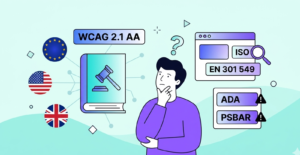
The 2024 Title II rule was the product of years of advocacy. It turned a vague legal duty into something specific: government bodies had to meet WCAG 2.1 Level AA by 26 April 2026. However, just a few days before the deadline, The Interim Final Rule took effect.
Government bodies are split into two groups based on the size of the population they serve:
Group 1
Government bodies serving populations of 50,000 or more: new deadline is 26 April 2027.
Group 2
Government bodies serving fewer than 50,000 people: new deadline is 26 April 2028.
Both groups have gained exactly one year. And the reason for the extension? The DOJ said it had underestimated how difficult compliance actually is: automated tools cannot reliably fix web content, specialist expertise is hard to find, and many government bodies don’t have the internal resources the original assessment assumed.
Disability advocates did not accept that reasoning. The American Association of People with Disabilities called the move a step backwards. Disability rights lawyer Lainey Feingold, who has spent decades working on digital access cases, urged the public to oppose the extension during the comment period. Two years should have been enough, they argued. The extension simply rewards the bodies that chose to wait.
There is also a signal worth noting: the DOJ has indicated it may pursue further rulemaking that could bring substantive changes to the 2024 guidelines themselves, not just the timeline. That adds another layer of uncertainty for government bodies watching this space.
The underlying message
There is a pattern in how accessibility deadlines move in the United States. They get revised. They get delayed. Each time, the organisations that had treated the deadline as optional reset to zero when enforcement eventually resumes.
And each time, the disability community absorbs the same message: that access to public services is something that can be postponed when it is inconvenient.
If you run a private business: what this means for you
Straight answer: the deadline extension does not apply to you. As mentioned above, private businesses sit under Title III of the ADA, which is not connected to the DOJ rule that just changed. You have always been exposed to accessibility lawsuits under the ADA, and that exposure has not shrunk.
If anything, it has grown. In 2025, more than 3,100 federal website accessibility lawsuits were filed, a 27% jump from the year before. Factor in state-level claims, and the total targeting digital properties exceeded 5,000. The majority of those cases landed on e-commerce and retail businesses, not government websites.
The financial exposure is real. Most cases begin with a demand letter, which typically costs a few thousand dollars to resolve. Let it escalate, and you are looking at five figures out of court, or significantly more if it reaches a judge. For a small business, even the early stages are disruptive enough to hurt.
New York, Florida, and California generate the bulk of filings, but the geography is expanding. If your business serves US customers online, from anywhere in the world, you are within reach.
If you’re thoroughly confused by this, you’re not alone. You can follow this simple quiz to find out where exactly you stand and what rules apply to your business.
Why UK and European businesses should be paying attention
If you are based in the UK or Europe, your first instinct might be to treat this as someone else’s news. It is not.
The ADA is the most heavily litigated accessibility framework in the world, and the pressure it creates shapes how platforms, vendors, and agencies build products globally. The accessibility decisions made for US audiences do not stay in the US.
Closer to home, the European Accessibility Act is already live. Swedish and Dutch regulators are conducting active inspections of e-commerce operators. The UK Equality Act and the public sector body accessibility regulations have not moved. None of that changes because Washington extended a deadline.
Don’t stop the work
For government bodies in the US that had been working toward the April 2026 deadline, the extension is not a signal to pause. Deque, whose accessibility tooling is widely used across the US government, published clear guidance at the time: keep going.
Work already done is not wasted. Progress toward WCAG 2.1 AA makes websites genuinely more usable for disabled people right now. Read more about the hidden benefits of web accessibility here.
An organisation that stops halfway through will need to restart later, probably having lost track of where things stood. For organisations that have not started, the extra year is a real opportunity, but only if used deliberately.
Where to start
Whether you are a government body working out how to use the extra year, or a private business wondering where you actually stand, the starting point is the same: find out what your site genuinely looks like to someone with a disability.
An honest manual accessibility audit tells you what needs fixing, in what order, and why. If you want that picture, get in touch, and we will walk you through it.
Sources
Related articles